With pleasure – here’s a clear, natural English version of the interview:
We are happy to return to our meetings with members of the Association, and I’m opening this new edition of the series, launched by my predecessor Julia Bromberek, with a conversation with our President.
PIB: Your work in ZASP – being President – is extremely demanding. It takes a lot of time, attention and emotion. When you leave the office, do you manage to rest, or do you never really “switch off” from ZASP? Is being President a 24/7 job?
KS: Unfortunately, you’re right. Having spent six years on the Main Board and then as President, there’s no time for anything else. Even if I tried to set fixed office days – say three or even four days a week – it would still be impossible to decide which days to choose. There is always something unexpected. A sudden call from the office: “Please come here or there, it’s extremely important for ZASP and for our entire community.” And you have to drop everything… because it truly is important.
Then there are farewells to our colleagues – neither they nor we get to choose those dates. And that’s especially important, not only as a tribute to those who have passed, but also for their families and for our community. At funerals of famous people crowds appear, but at those whose glory has already faded… it’s hard to find people willing to say goodbye. Sad, but true.
Very often in recent years I have not only said farewell to artists, but also taken care of organising the entire ceremony. There are moving and uplifting moments, but they are no less demanding and always at the cost of private life.
Then there are gala premieres, jubilees, presentations of decorations, meetings in regional branches, and extremely exhausting talks with decision-makers who have decided to stop funding this or that theatre – that’s my everyday reality. These trips last several days. I’m often away from home, but despite the tiredness it’s a great joy when something actually works out. That was the case, for example, with the Teatr Dzieci Zagłębia, the theatres in Zabrze, Lublin, Łódź, Kraków, Legnica… and several others, where we managed to convince the ensemble or the organisers to change their decision.
On top of that, there’s the daily need to read regulations and laws, to sign and approve hundreds of documents, congratulatory letters, official replies, and so on.
PIB: Before becoming President, you were not only directing and working in radio, but above all doing something that now clearly had to move a little to the background and has become your hobby – carriages…
KS: Back then life was very pleasant and comfortable. Fourteen years ago I handed the company over to my son. I became a free man. And when – really by accident – I chaired the general assembly of our association and got involved in the work of the Veteran Artist Foundation, I was suddenly asked to join the Main Board. Then I was elected Vice-President, then after Paweł Królikowski passed away – President. And that’s how it has been to this day.
I’m not complaining, I’m just answering your question to show how impossible it is now to fully pursue not only my hobby, but also to find time for work in radio or in theatre. Sadly, my closest family also suffers from this.
All right, but that’s not what we were supposed to talk about. In my life, horses, dogs and motorbikes have always been important, and theatre somehow happened along the way. I come from a family – on both my mother’s and father’s side – of horse breeders and artists. For as long as I can remember, actors came to our house. I really didn’t like them, because they always talked only about themselves and always complained about something. But the horse people – the stables – that was a magical, wonderful, sunny world.
My grandfather was director of stallion studs after the war. So I had unlimited access to studs and stallion depots all over Poland. I rode horses from childhood. As a teenager I trained in the riding section of the Legia Warsaw club and later studied to become a jockey at Służewiec racecourse. After the summer holidays in 10th grade, I suddenly turned from a small boy into a big man: I grew and gained weight – that’s why I didn’t become a jockey.
After my final exams I applied to the National Academy of Dramatic Art, to the Warsaw University of Life Sciences (SGGW) and to the Circus School in Julinek. I got into animal science and… the circus school. When my mother found out about the circus, she went to Julinek and took my papers back. Unfortunately, at that time I was already doing extra work for Adam Hanuszkiewicz at the National Theatre and the Powszechny Theatre; I spent entire days in rehearsals and had no time to study. I was thrown out after the first year, but I passed the entry exams again and… was once more completely absorbed by theatre.
It was then that I first used my skills: horse riding, animal training and stunt motorbike riding (my father was a rally rider). I worked on films as a stuntman, trained dogs for films and for productions at Teatr Mały, and did crazy motorbike stunts as Goplana in Balladyna at the National Theatre…
All the while (in the so-called meantime), thanks to my father, I was able to develop my own concept of horse breeding. My father ran an agricultural cooperative in Cybulice near Warsaw. The co-operative gave me permission to buy four broodmares. I had them covered exactly as I had planned. I invited friends from the theatre – Marcin Sławiński, Wiktor Zborowski, Marek Siudym, Krzyś Kolberger, and Witek Dębicki – and we roamed the Kampinos Forest on horseback. That’s where I got my first carriage and harnessed to it a young stallion I had bred myself – Eryk. I invited actresses and showed off my driving skills. Among them there was one who mattered most to me – a very young ballerina from the Teatr Wielki in Warsaw, Ewunia Głowacka. On Mondays, our day off, we took long carriage rides through the forest.
So that’s how I lived, carefree, earning huge money in Balladyna and in A Month in the Country and applying every year to the Warsaw theatre school… and to avoid compulsory military service for young men, I studied animal science. I even reached the third year.
Finally, on my fifth attempt, I was admitted to the Acting Department of the Łódź Film School.
After my first year, our tutor Jan Machulski offered me the role of the Prince of Verona in an outdoor production on the market square in Zamość. And I suggested that I would play the role on horseback. My mares in Cybulice had foals at the time, so I went to Biały Bór near Koszalin and bought a riding horse called Karny (I renamed him Bolek), spending all the money I had put aside for the horse and for transport. I got on his back and in two weeks rode to Zamość.
Throughout my second and third year I commuted by horse from Warsaw to Łódź on Sundays and back on Saturdays (120 km). I always arrived at dawn. It was wonderful when on Mondays, from 7 a.m., Bolek stood tied to a lamp post outside the ballet studio while his owner was being tormented by Janka Niesobska’s ballet classes.
After school I joined Teatr Rozmaitości and there I met a wonderful colleague, actor Zbigniew Prus-Niewiadomski. This outstanding expert on the history of riding, carriage driving and historical carriages infected me with the passion for collecting. Since neither he nor I played leading roles, we had a lot of time to sit in the theatre café. I soaked up his stories and knowledge at every free moment. That’s how it all began.
I decided to collect old carriages. From my parents I inherited several garages on Saska Kępa. And a garage – as the name suggests – is used for storing carriages (laughs). That’s where I started keeping my buggies.
At that time I didn’t yet have the money to restore them. When I had built up a sizeable collection, an accident happened. During a performance I broke my spine on stage. The doctors were clear: you will never again get on a horse or a carriage. At that time I had two carriage horses. I kept them in a rented stable on the Mokotów Fields. They were sold, and from the collection of 16 carriages I gave 15 away to friends and acquaintances. I hoped they were going to good homes. I sold only one beautiful antique hunting carriage together with an old harness to the Warsaw University of Life Sciences.
What do you think – how many carriages from that collection have survived to this day?
PIB: I have no idea. Fifteen?
KS: Only the one I sold.
Right after the accident I started directing. First dubbing, then in theatre.
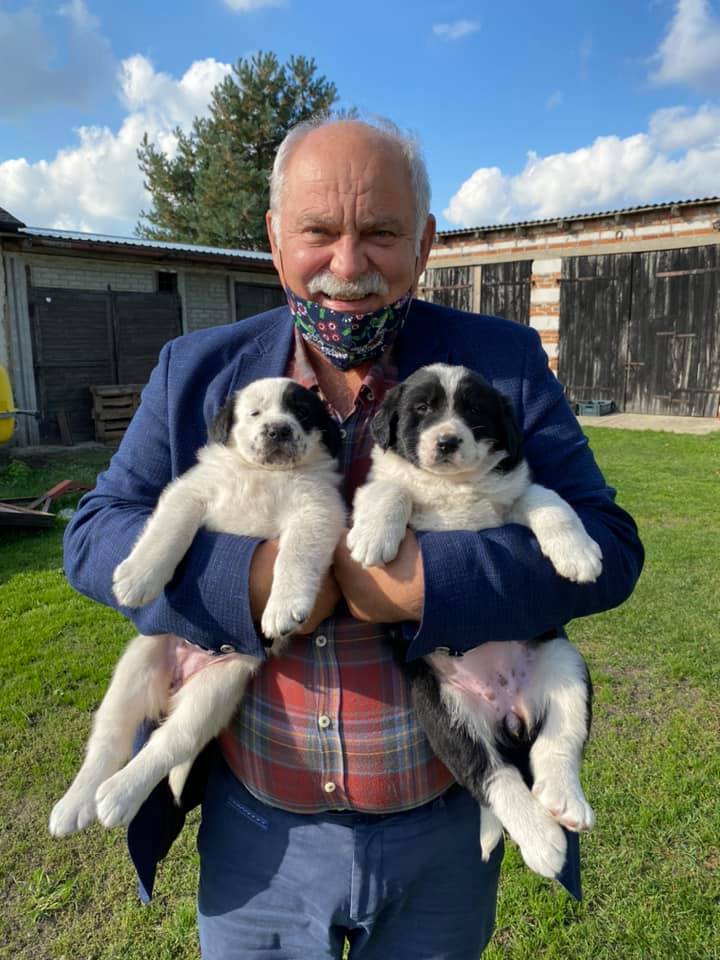
Since childhood I have also been fascinated by dog breeding. There were always dogs in our house, and always hunting breeds. I loved working with them, teaching them various tricks and, most importantly, obedience. I was invited with my dogs to hunts (to retrieve and track) so that they could assist the hunters. My dogs appeared in many films and television productions. The highlight of their career – and mine as a trainer – was A Month in the Country at Teatr Mały. I also became a hunter – although today one shouldn’t admit that openly.
But I’ll wait – when more and more wild animals start coming into cities after the wild boars, then “city folk” will start asking hunters for help and will see them differently. But let’s leave that.
I had to mention hunting because it allowed me to finance my horse hobby and museum passion. I turned my hobby into a profession. I knew a lot about hunting gear and thus also about hunting and sporting firearms. Together with my wife we opened a hunting shop and later a wholesale business. My spine healed reasonably well, so I returned to my old passion – horses.
At that time I had two more carriage horses. My daughter started dressage training. I bought her three stallions to compete on. I was happy that my children were following in the footsteps of our ancestors. Both my sons also ride and drive very well to this day. And last year my 13-year-old granddaughter took part for the first time in two international traditional driving competitions. She won in her class, beating even the senior drivers.
But back to those five horses. They were scattered across several stables near Warsaw. We wasted a lot of time travelling between them. So we made a decision: either we buy some bankrupt State Agricultural Farm, or we build our own stud. Thanks to my wise wife, we chose the second option.
And so for 25 years we’ve been living 30 kilometres from Warsaw, running our own place.
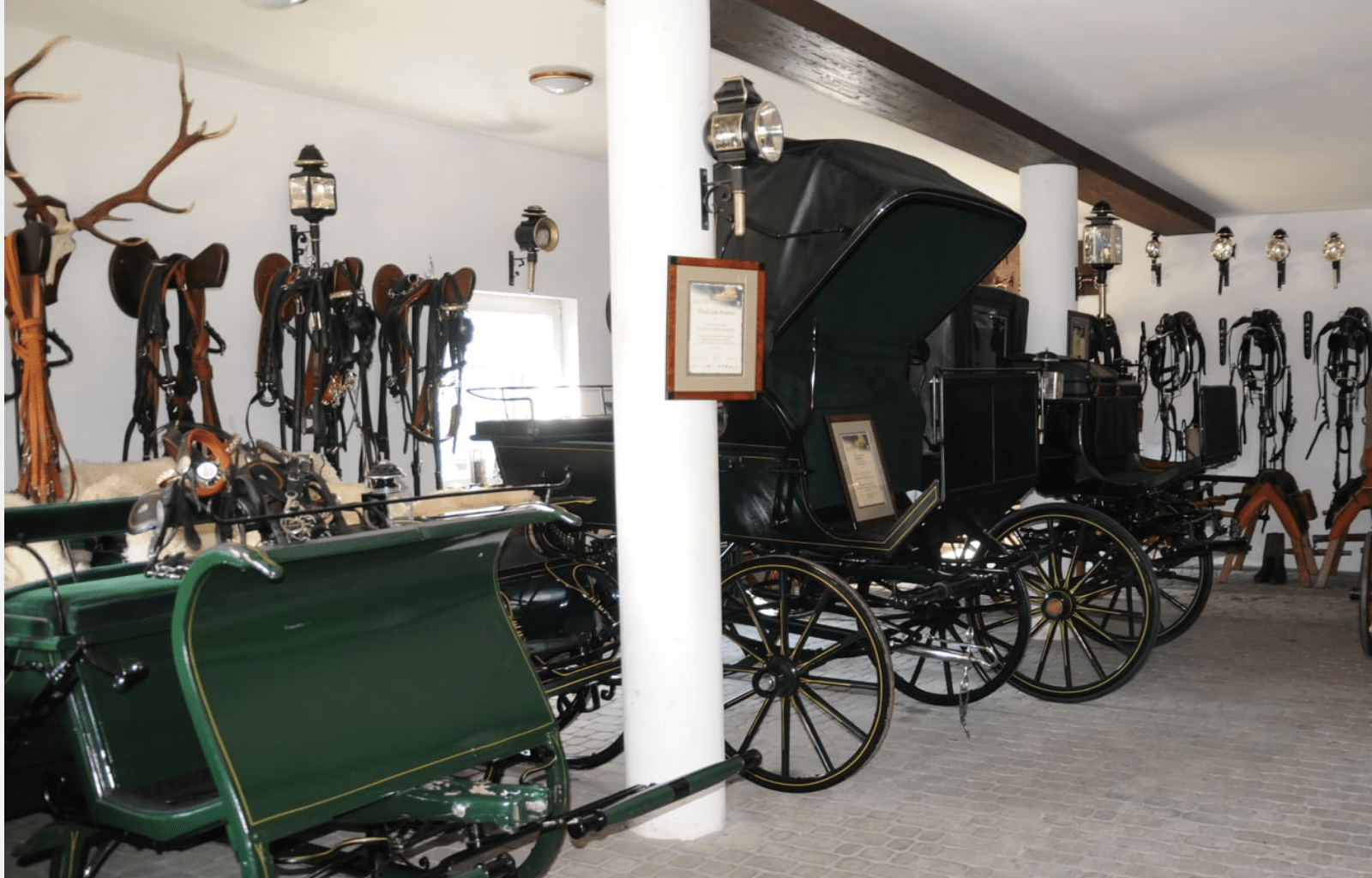
We built not only a stable, but also a carriage house and, two years later, a museum.
The horses have large pastures, and I became not only a breeder, but also a farmer. I love working the land.
PIB: Breeder, farmer, museum owner… Do you have many items in your museum?
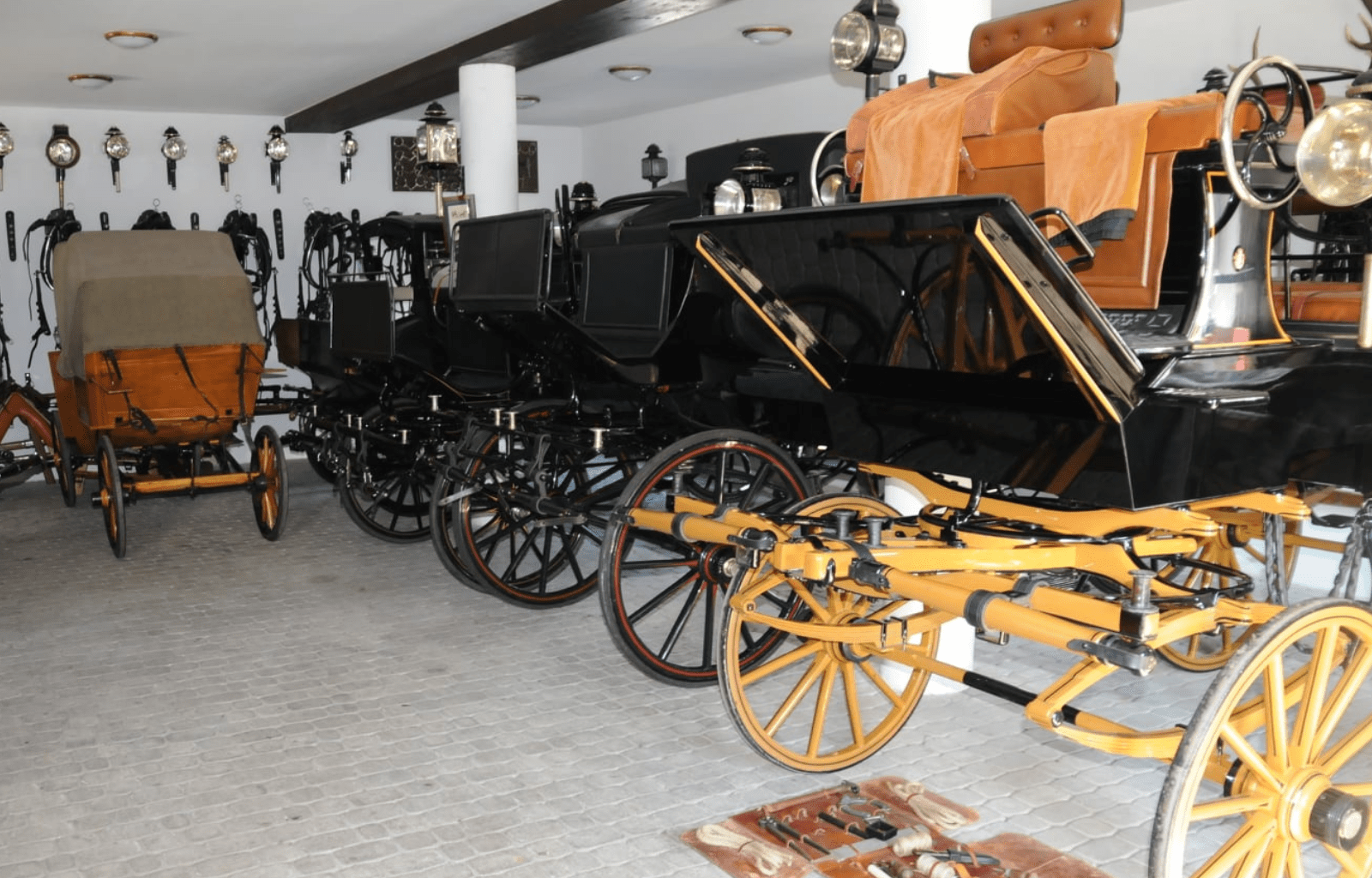
KS: Over 25 years I’ve gathered 64 carriages, 8 sleighs, countless sets of harnesses, saddles and carriage accessories, 14 horse-drawn fire pumps and one fire ladder on wheels from 1900.
PIB: I know all the objects you just mentioned, but horse-drawn fire pumps? How did they end up in your collection?
KS: Since childhood I’ve been fascinated by watching fire brigades racing to fires.
When I realised that my collection was missing a fire pump, I bought one that was in terrible condition and had it restored. And when it came back after restoration, I simply fell in love with it – and to “weaken” that love, within a few years I had 14 of them.
PIB: Have all the items in your collection been restored?
KS: In the old days, when people travelled only by horse-drawn vehicles, you had to overhaul them after every spring-autumn season. The same with sleighs after winter.
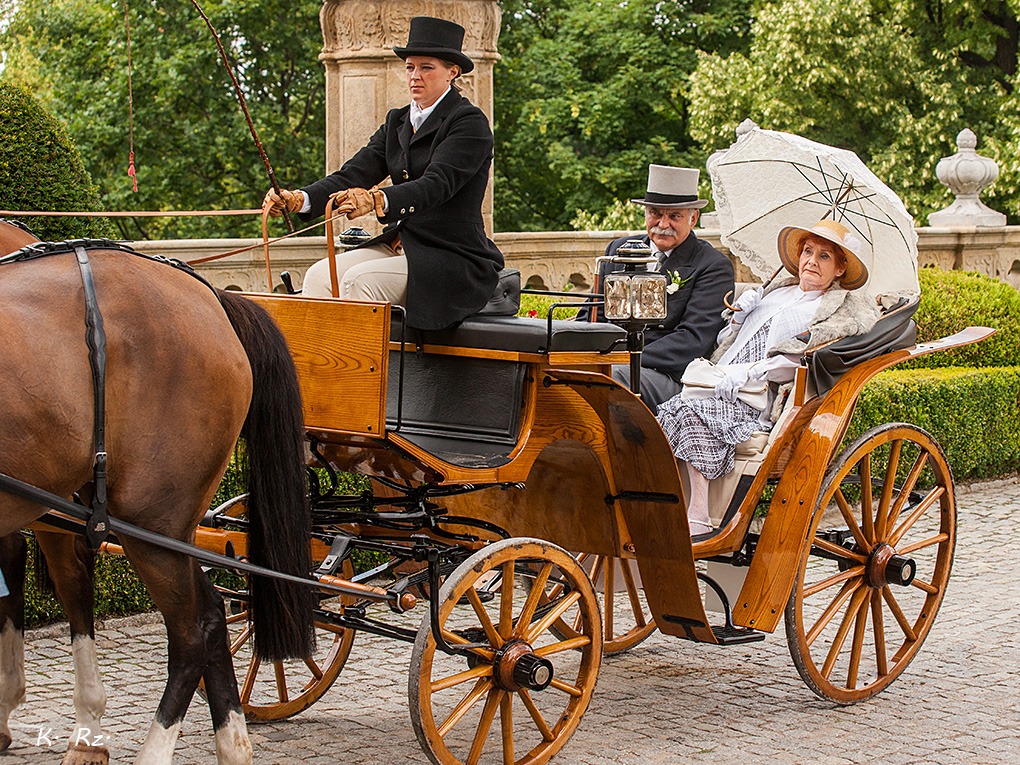
I called my museum a carriage house and treat all the vehicles according to one rule: any visitor who comes in can say, “I’d like to ride in this or that carriage,” and we can immediately harness the horses and give our guest that pleasure. Whenever I acquire a carriage, I restore it right away. Ninety percent of them are historic pieces, so we have to meet very strict requirements in order to bring back their former glory: in harmony with their character and, most importantly, with their original appearance. I take care of every detail. All the exhibits are in full working order.
PIB: How do you find new exhibits? Do owners contact you themselves? Do you drive around villages, old manors and palaces like ethnographers used to do? Do you bid at auctions?
KS: In the past, when there was no internet, I really did drive around barns – in Poland, the Czech Republic, Germany, Belgium, France and the Netherlands. Now I keep a close eye on advertisements and auctions.
I managed to save a collection of 8 carriages from the Stallion Stud in Bogusławice. When I learned in the early 2000s that the stud had gone bankrupt and the carriages had been pledged to a bank, I bought the entire collection – with the consent of the Ministry of Culture and the Ministry of Agriculture.
PIB: That must have cost a small fortune…
KS: Yes, a lot – let’s leave it at that. Nowadays many people approach me and offer to sell their family carriages. Unfortunately, I’m completely overwhelmed by the number of exhibits and only buy real “white ravens” – absolute rarities.
Last year I built another floor for the museum. And within a few months I was again struggling with a lack of exhibition space.
PIB: Today your Carriage Museum is famous – probably not only in Poland. Are there any true gems among the exhibits? Special pieces? Your favourites?
KS: Oh yes. I actually bought the entire Bogusławice collection for the sake of one carriage. It’s the break carriage of Prince Sanguszko, ordered by him in 1900 from a renowned German company. It is the only one of its kind in the world. It’s like commissioning a one-off model of a racing car today.
But with cars, and equally with carriages, what matters most is not who built them or where, but who used them. Who sat in them. In my collection I have a landau used by President Ignacy Mościcki, a victoria in which Józef Piłsudski once rode, the only milord carriage made by the Warsaw firm Hertel, the only wooden horse-drawn fire ladder in Poland, and one of the oldest horse-drawn fire pumps in Poland, dating back to Napoleonic times – 1812.
PIB: If there are carriages, someone has to drive them. Carriage driving has become a competition sport…
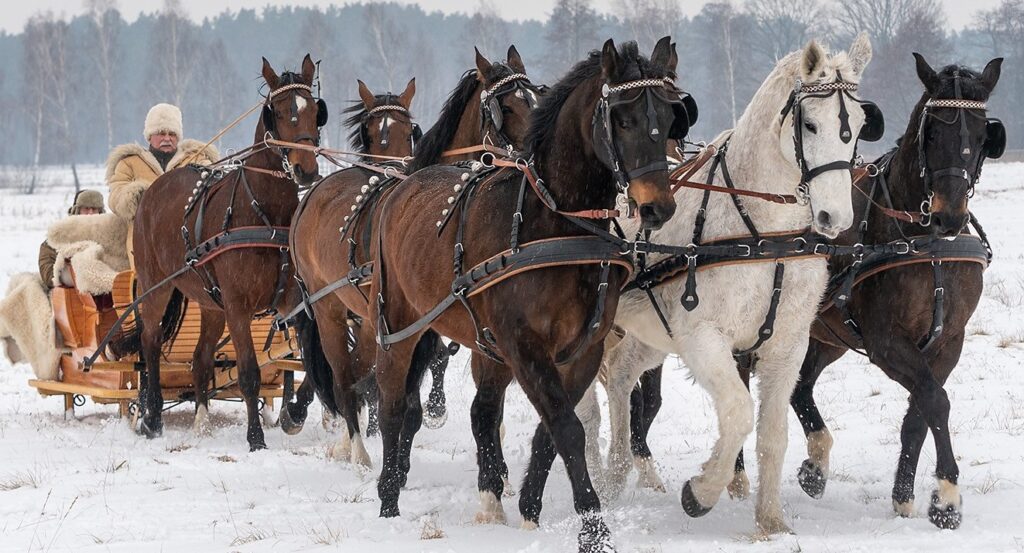
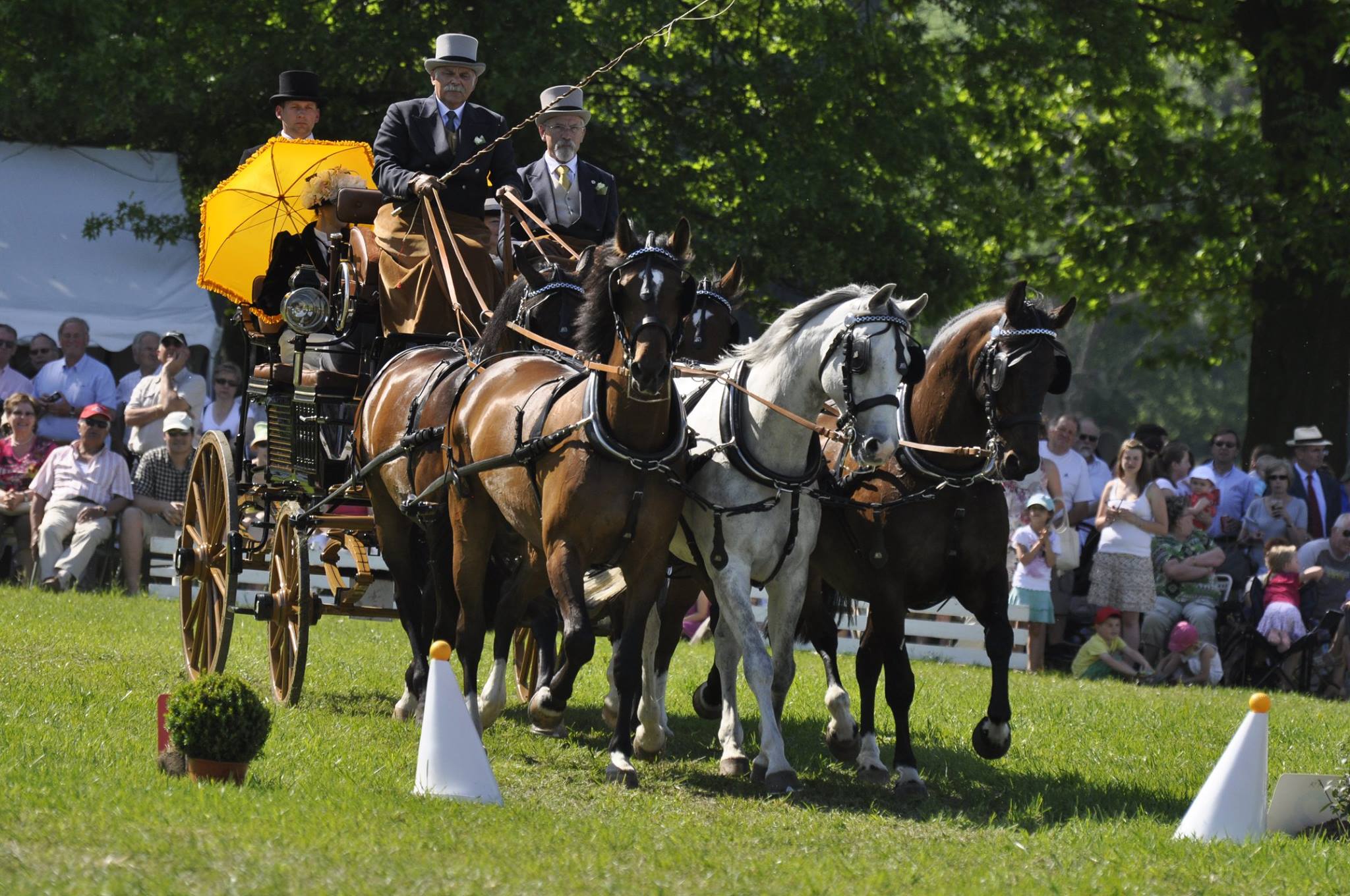
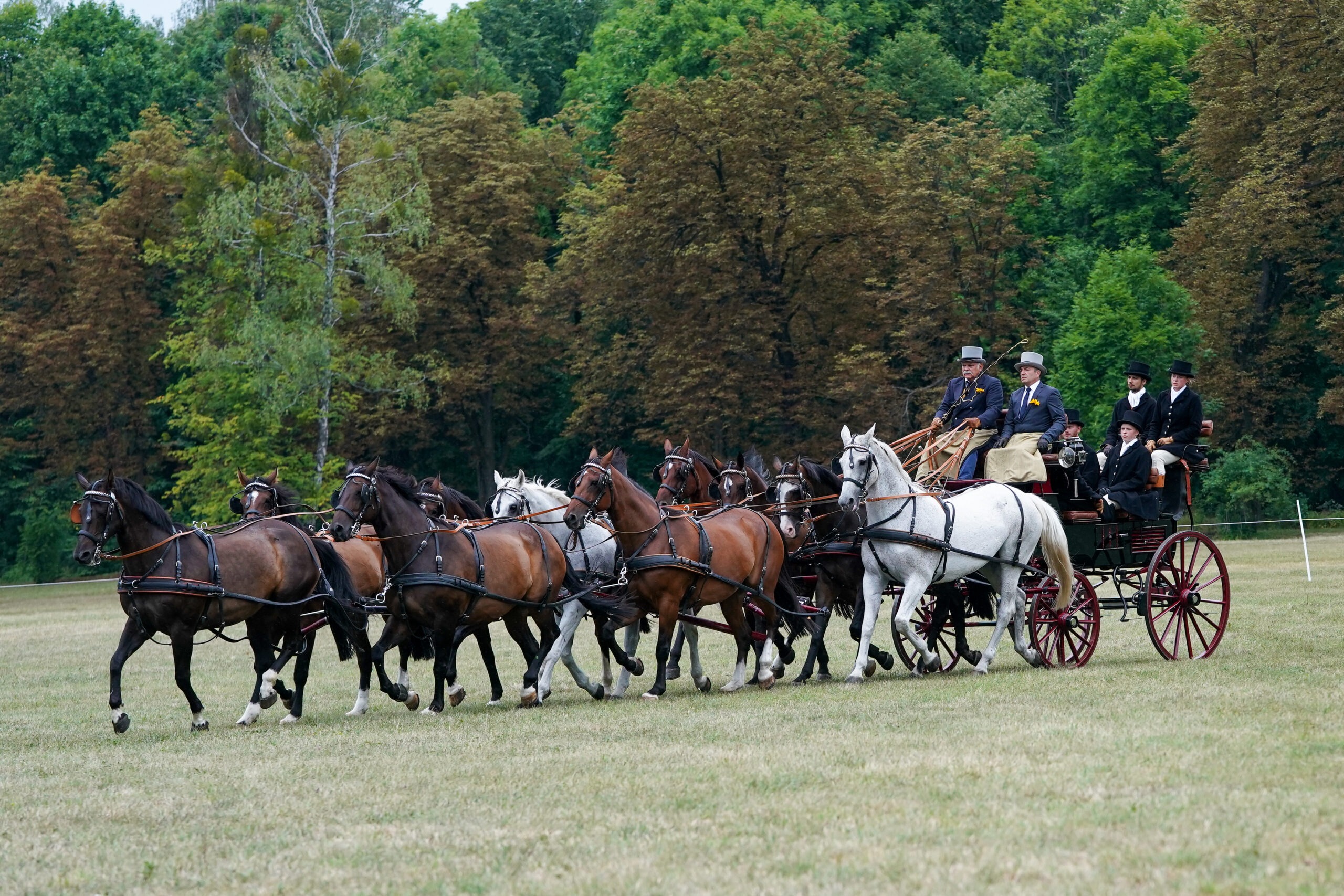
KS: I’m one of the few people who reintroduced traditional driving competitions in Poland. We drive only carriages built before 1945. Such competitions have been held for 30 years all over Europe. In 2012 I became European champion at the International Competition in Cuts near Paris. I drove the famous Prince Sanguszko break, hitched to a team of five horses. In 2018 I set a Guinness record, driving ten horses (from my own stud) in a fan formation. I’m very proud of those two performances.
PIB: Can your exhibits be hired, for example, for film productions, shows or historical re-enactments?
KS: I don’t hire anything out for films! Today’s directors and set designers have no idea about the history of travel. They think horses only moved at a gallop – because it looks good on camera. They don’t respect the exhibits. Restoring one historic carriage costs at least 30,000 złotys. And the hire fees they offer are peanuts. Let others do that.
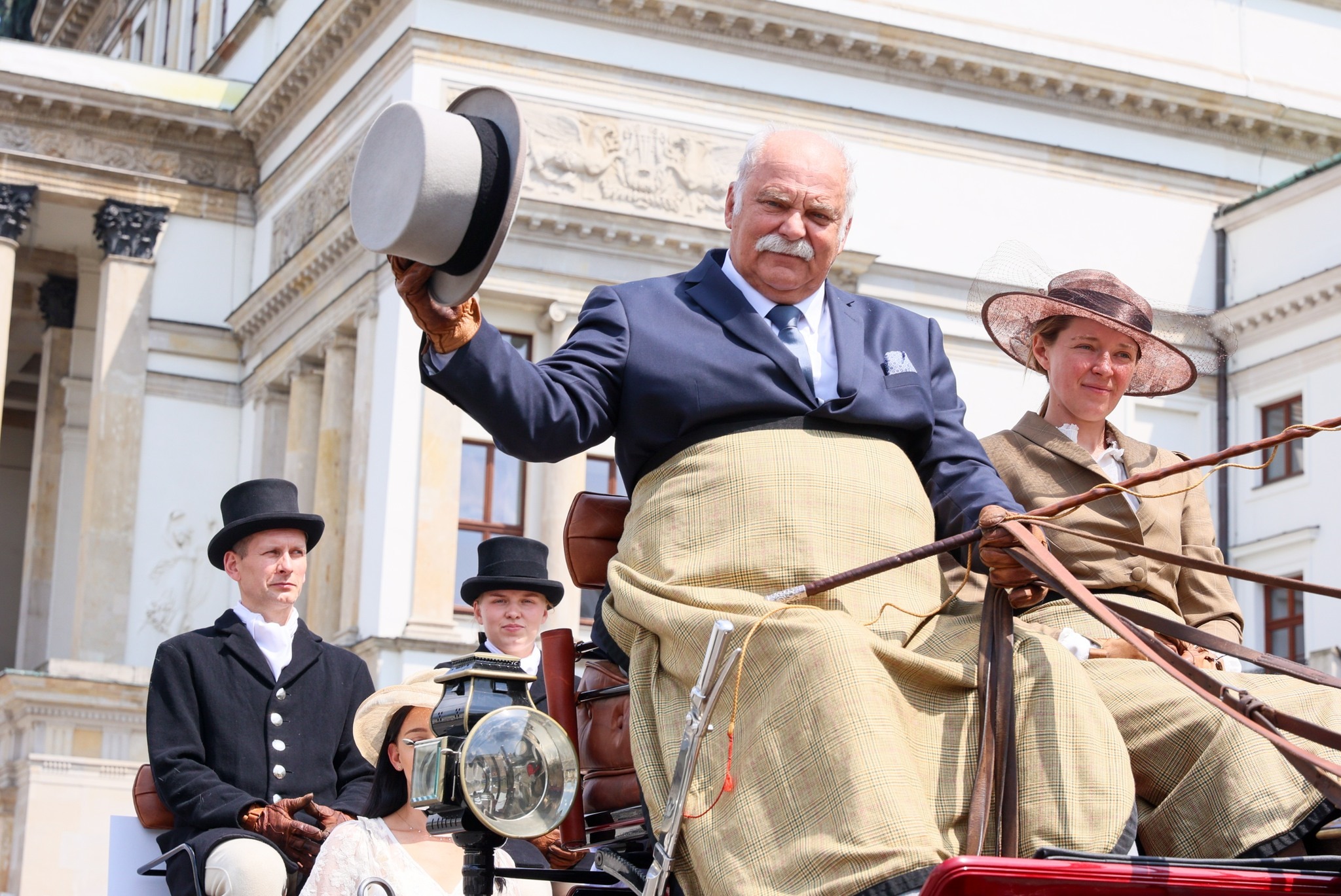
But for shows, where I drive myself or where my trained staff drive – very gladly. Every year I organise so-called korsa – parades of historic carriages through the streets of Warsaw. I took part in a show at the National Stadium on the centenary of regaining independence. I drove the figure of Józef Piłsudski in a landau hitched to six horses. I arranged carriage rides for the residents of Skolimów. And at Christmas there, the real Santa Claus arrived not in a sleigh pulled by reindeer, but by my mares.
Several times I have driven a five-horse team along the Royal Route, collecting donations and encouraging people to donate 1.5% of their tax to the Veteran Artist Foundation.
PIB: Thankfully, as you’ve already told us, your family shares your passion.
KS: The most important thing is that my wife Monika accepts my passion and supports me. My daughter Zosia was a multiple Polish dressage champion and is now a trainer in that discipline. My son Adam used to ride very well and, like his father, did some stunt riding, but he let that go and now runs our family business. My son Rafał drives and rides brilliantly, and our stable manager – my protégé, Justyna Przyborowska – is the most highly titled lady driver in Europe, often beating the men in pairs, tandems and four-in-hand competitions. And our granddaughter Lila is also doing very well.
PIB: What are your plans for the near future – some dream new exhibit? Museum expansion? A big event?
KS: No more exhibits, that’s enough. Soon there’s a big conference in Spain, then the European Championships in Compiègne in France, an international competition in Seville, and in autumn the Czech Republic. And two wonderful Polish events: an international competition in Koszęcin, at the seat of the “Śląsk” Ensemble, and another in Niepołomice. But in these competitions only Justyna and Lila will be starting. Sadly, because of my work in our Association I haven’t trained for four years, although I miss it very much and would love to sit on the box seat again.
I’ll just add that I am an international driving judge and I’m invited to many competitions all over Europe. And my everyday life (now and in the future) is this: every evening, as the owner, I’m in the stable. I give each horse a carrot or an apple, and they always greet me with a neigh. “The master’s eye fattens the horse,” as the saying goes.
PIB: How many horses are waiting for you in the stable?
KS: Fourteen. In recent years a few have gone to the forever-green pastures. My wife and I never give our horses away or sell them. They were born with us, work with us, so they have the right to a dignified old age with us as well. They are part of our family.
PIB: What should we wish you in connection with your passion?
KS: Health – and that my wife stays just as understanding, and that all our grandchildren follow in the footsteps of their great-grandparents.
Interview by
Paulina Iwińska-Biernawska